Top 5 Chemical Companies: Insights Into Chemical Manufacturing and Industry Roles
Chemical companies play an important role in producing the materials and chemical building blocks used throughout modern life.
From plastics and coatings to agricultural materials, electronics, packaging, transportation, and construction, chemical manufacturing connects raw materials with many everyday products. This overview examines five major chemical companies—BASF, Dow, SABIC, Mitsubishi Chemical Group, and LyondellBasell—and explains their roles within the wider chemical industry.
Context
Understanding Chemical Manufacturing
Chemical manufacturing involves transforming raw materials into substances that can be used directly or as ingredients in other production processes. Raw materials may include natural gas, crude-oil derivatives, minerals, agricultural inputs, air, water, and renewable feedstocks. Through controlled reactions and processing, manufacturers create basic chemicals, intermediates, polymers, specialty materials, and other compounds.
The industry is divided into several areas. Basic chemicals form the foundation for many industrial processes, while intermediates are processed further into other materials. Polymers are used in products such as packaging and vehicle components, while specialty chemicals can provide specific properties such as resistance, flexibility, conductivity, or protection.
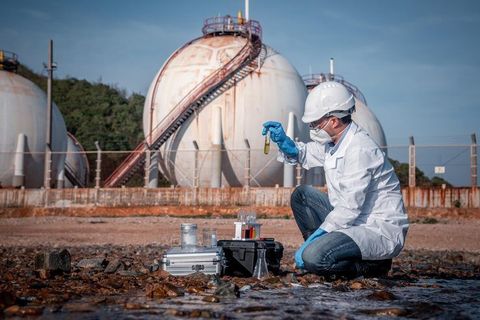
Chemical manufacturing also involves extensive safety controls. Facilities use monitoring systems, process controls, containment equipment, laboratory testing, and established handling procedures to manage potentially hazardous substances and complex production conditions.
Five Major Chemical Companies
The phrase “five major chemical companies” can refer to different groups depending on geography, product category, revenue measurement, or production scale. The following companies provide useful examples of how large chemical manufacturers operate across different parts of the global industry.
| Company | Main areas | Examples of industry roles |
|---|---|---|
| BASF | Chemicals, materials, agricultural products, surface technologies | Basic chemicals, intermediates, materials |
| Dow | Materials science, polymers, industrial chemicals | Packaging, infrastructure, electronics, industrial applications |
| SABIC | Chemicals, polymers, agri-nutrients | Petrochemicals, polymers, industrial materials |
| Mitsubishi Chemical Group | Performance products, chemicals, materials | Specialty materials, polymers, industrial applications |
| LyondellBasell | Polymers, chemicals, refining | Polyolefins, intermediates, circular materials |
BASF operates across several divisions, including chemicals, materials, industrial solutions, nutrition and care, surface technologies, and agricultural solutions. Its Chemicals segment includes petrochemicals and intermediates that support downstream manufacturing.
Dow focuses on materials science and chemical manufacturing, with applications covering areas such as packaging, construction, electronics, transportation, agriculture, and industrial production. Its reporting also highlights sustainability, materials innovation, and circular-economy activities.
SABIC operates across chemicals, polymers, and agri-nutrients. Its chemical portfolio includes petrochemical building blocks, glycols, methanol, industrial gases, aromatics, and other chemical products.
Mitsubishi Chemical Group represents another model, with activities spanning performance products, chemicals, polymers, and advanced materials. LyondellBasell has a strong connection to polymers and chemical intermediates, illustrating how large manufacturers can focus on specific portions of the chemical value chain.
Importance
Why Chemical Companies Matter
Chemical manufacturing affects many industries that people encounter without necessarily recognizing the connection. Food packaging, household products, automobiles, computers, building materials, textiles, paints, agricultural products, and medical equipment can all depend on chemical materials or processing.
A chemical company may therefore operate several steps away from the final product. For example, a manufacturer may produce a polymer that another company converts into packaging. The packaging manufacturer then supplies another organization that uses it for food, household, or industrial products.
This interconnected structure means chemical production is closely connected with global manufacturing. Disruptions involving raw materials, transportation, energy availability, environmental rules, or production capacity can affect multiple industries.
Challenges Facing the Industry
Chemical manufacturers face several practical challenges:
- Managing energy and raw-material requirements
- Maintaining safe production environments
- Controlling emissions and industrial waste
- Developing materials with lower environmental impacts
- Adapting to changing regulations
- Maintaining reliable supply chains
- Responding to changes in regional demand
- Increasing the use of recycled or renewable feedstocks
The industry also has to balance production efficiency with environmental considerations. Chemical processes can require significant energy and generate emissions, so manufacturers are increasingly examining electrification, renewable energy, recycling, carbon management, process optimization, and alternative feedstocks.
Recent Updates
Market Conditions and Production Trends
Recent industry reporting shows that chemical markets have experienced uneven regional conditions. BASF reported global chemical-industry production growth in 2025, while also identifying significant differences between regions. Its report indicated stronger production growth in China and weaker conditions in several other markets.
Industry analysis has also highlighted persistent uncertainty, excess production capacity, changing trade patterns, and relatively weak demand in some chemical markets. These conditions have encouraged manufacturers to examine production efficiency, portfolio structure, investment priorities, and operational resilience.
Sustainability and Circular Materials
Sustainability has become an increasingly important area of chemical manufacturing. Companies are examining ways to reduce greenhouse-gas emissions, increase recycling, use renewable energy, and develop materials that can participate in circular production systems.
Dow's recent reporting describes activities involving emissions reduction, circular-economy approaches, water and nature considerations, and materials designed around sustainability objectives.
SABIC has also reported developments involving circularity and lower-carbon chemical materials, including commercial activity involving low-carbon methanol produced using captured carbon dioxide.
Digitalization and Advanced Manufacturing
Digital technology is another continuing industry trend. Chemical manufacturers are applying data analytics, automation, artificial intelligence, process monitoring, and digital models to understand production systems and improve decision-making.
SABIC's reporting identifies digital transformation, analytics, computational capabilities, and generative AI as areas of development within its broader digital strategy.
These technologies can help production teams monitor equipment, identify unusual operating conditions, analyze large datasets, and understand complex manufacturing processes. Their practical value depends on data quality, system integration, cybersecurity, and appropriate human oversight.
Tools and Resources
Industry Information Sources
Readers researching chemical companies can use several types of resources to understand the sector:
- Annual reports for business segments, production activities, and corporate developments
- Sustainability reports for environmental and resource-related information
- Chemical databases for substance properties and classifications
- Regulatory databases for chemical handling and environmental requirements
- Industry publications for market developments and manufacturing trends
- Educational chemistry platforms for foundational concepts
- Safety data sheets for information about chemical hazards and handling
Annual reports are particularly useful because they explain how a company organizes its activities and identifies its major business areas. BASF, Dow, and SABIC publish corporate reporting that provides information about their operations and current industry conditions.
Understanding Chemical Value Chains
A value-chain diagram or process map can also help readers understand how chemical manufacturing connects different industries. A simplified chain may look like:
Raw materials → Basic chemicals → Intermediates → Polymers or specialty materials → Components → Finished products
Not every chemical follows this exact path. Some materials move through several processing stages, while others may be used directly in industrial applications.
FAQs
What do chemical companies manufacture?
Chemical companies manufacture substances such as basic chemicals, intermediates, polymers, specialty materials, industrial gases, and agricultural inputs. The exact portfolio differs between companies.
What are five major chemical companies?
BASF, Dow, SABIC, Mitsubishi Chemical Group, and LyondellBasell are examples of large international chemical companies with activities across different parts of the chemical value chain.
Why are chemical companies important to manufacturing?
Chemical companies produce materials and ingredients used by industries including packaging, construction, transportation, electronics, agriculture, textiles, and consumer products.
How are chemical companies changing their manufacturing processes?
Current developments include greater digitalization, process automation, circular-material initiatives, emissions reduction, renewable energy use, and research into alternative raw materials.
What should readers examine when comparing chemical companies?
Useful areas to examine include product categories, geographic presence, manufacturing activities, research and development, environmental reporting, production technologies, and the industries supplied.
Conclusion
Chemical companies form an important part of the global manufacturing system by producing basic chemicals, intermediates, polymers, and specialized materials. BASF, Dow, SABIC, Mitsubishi Chemical Group, and LyondellBasell illustrate different approaches to chemical manufacturing and value-chain participation. Recent industry developments have centered on market uncertainty, sustainability, circular materials, digitalization, and production efficiency. Understanding these areas provides useful context for recognizing how chemical manufacturing connects raw materials with everyday industrial products.

Related Post...
Smart Grid Energy Systems Insights for Efficient Electricity Management
Updated: October 19, 2026
Read More
Commercial Event Generator Rentals Guide for Reliable Event Power Planning
Updated: October 19, 2026
Read More
High-Capacity Commercial Battery Storage Factory Systems Insights for Large Facilities
Updated: October 19, 2026
Read More