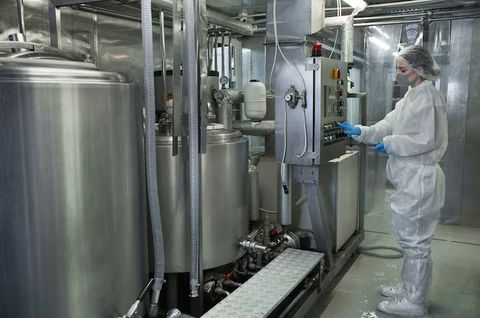
PVC Laminate Production Line Explore Manufacturing Processes and Equipment
A PVC laminate production line is an industrial arrangement of machines used to manufacture decorative or functional laminate sheets containing polyvinyl chloride (PVC).
These sheets can be used for interior surfaces, furniture components, wall applications, doors, panels, and other manufactured products. The production process generally combines material preparation, mixing, sheet formation, surface treatment, printing or pattern application, lamination, cooling, and finishing.
PVC laminates are produced from PVC resin along with selected additives that influence flexibility, appearance, stability, and processing behavior. Depending on the intended application, manufacturers may also use pigments, stabilizers, plasticizers, fillers, and other formulation components.
How the Production Line Works
The manufacturing process is arranged as a sequence because each stage affects the following stage. Raw materials are prepared before entering processing equipment, while the finished sheet passes through cooling, trimming, inspection, and packaging stages.
A typical PVC laminate production line may contain:
- Raw-material weighing and feeding equipment
- High-speed mixing equipment
- Extrusion equipment
- Calendering or sheet-forming equipment
- Cooling units
- Printing or surface-treatment equipment
- Lamination equipment
- Trimming and cutting systems
- Inspection and winding equipment
The exact arrangement varies according to laminate thickness, surface appearance, production method, and final application.
Importance
Role in Modern Manufacturing
PVC laminate production is relevant to several manufacturing sectors because laminate sheets can provide decorative surfaces while also supporting practical requirements such as easy cleaning and resistance to everyday surface wear. They are commonly associated with furniture, interior panels, doors, cabinetry, and other finished products.
The production line matters because consistent sheet formation requires controlled temperature, pressure, material flow, cooling, and surface processing. Small changes during these stages can affect thickness, appearance, texture, flexibility, and dimensional stability.
Main Manufacturing Challenges
Manufacturers working with PVC laminates need to manage several variables throughout production. Material composition must remain consistent, while processing conditions need to remain within suitable operating ranges for the selected formulation.
Common production considerations include:
- Maintaining uniform sheet thickness
- Controlling extrusion temperature and material flow
- Managing cooling rates
- Producing consistent surface textures
- Aligning printed patterns with the sheet
- Reducing surface defects and contamination
- Trimming sheets accurately
- Monitoring finished-product dimensions
Quality inspection is therefore integrated into multiple stages rather than being limited to the end of production.
Equipment and Their Functions
Different machines perform specific functions within the PVC laminate production line. Extruders melt and transport the prepared PVC compound, while forming equipment converts the processed material into sheets with controlled dimensions.
| Equipment | Main function | Typical process stage |
|---|---|---|
| Mixer | Blends PVC resin and additives | Material preparation |
| Extruder | Melts and transports the compound | Sheet formation |
| Calender | Forms and controls sheet thickness | Sheet production |
| Cooling unit | Reduces sheet temperature | Cooling |
| Printing system | Applies decorative patterns | Surface processing |
| Embossing unit | Creates surface textures | Finishing |
| Laminating unit | Combines material layers | Lamination |
| Trimming system | Removes uneven edges | Finishing |
| Inspection system | Checks visible and dimensional qualities | Quality control |
Recent Updates
Process Automation
From 2024 through 2026, manufacturing trends have continued moving toward greater process monitoring and automation. In PVC laminate production, this can involve sensors that monitor temperatures, material movement, line speed, pressure, and other operating conditions.
Automated monitoring can help operators identify variations during production rather than relying entirely on final inspection. Digital control systems can also record process information for later analysis and production documentation.
Improved Surface Processing
Decorative appearance remains an important area of development in laminate manufacturing. Production systems increasingly support combinations of printing, embossing, texturing, and protective surface layers to create different visual and tactile effects.
Digital printing technologies have also expanded the range of patterns that can be reproduced on manufactured surfaces. Depending on the production setup, printed designs may represent wood patterns, stone-like appearances, colors, geometric designs, or other decorative effects.
Material and Energy Considerations
Manufacturing discussions during 2024–2026 have also placed greater attention on material efficiency, energy use, waste reduction, and recycling within plastics processing. These considerations can influence equipment selection, process monitoring, scrap management, and formulation development.
PVC processing requires controlled heating and cooling, so production systems can incorporate process controls intended to manage energy use while maintaining appropriate manufacturing conditions. Recycling approaches depend on the composition of the material and the presence of coatings, inks, adhesives, or other layers.
Greater Process Integration
Modern production lines can combine multiple operations into a continuous workflow. Instead of treating extrusion, surface treatment, lamination, trimming, and inspection as completely separate activities, integrated systems can coordinate these stages through centralized controls.
This approach can make production data easier to monitor and can reduce the need for repeated manual adjustments. However, the specific degree of automation varies between manufacturing facilities and product requirements.
Tools and Resources
Production Planning Tools
Several types of tools can help people understand or plan a PVC laminate production process. Process-flow diagrams are useful for mapping the movement of raw materials from preparation through finished-sheet inspection.
Material-balance spreadsheets can also be used to record input quantities, production output, and process losses. Basic calculations can help explain how material usage changes when sheet thickness, width, or production volume changes.
Equipment Monitoring Resources
Digital control panels and industrial monitoring systems can display variables such as temperature, pressure, line speed, and equipment status. Manufacturers may also use sensors and data-recording systems to identify changes in operating conditions.
Technical manuals, equipment documentation, material data sheets, and industrial standards are additional resources for understanding machine functions and material characteristics. Their relevance depends on the particular formulation and production equipment.
Quality-Control Resources
Quality checks can include measurements of sheet thickness, width, surface appearance, color consistency, dimensional stability, and physical characteristics relevant to the intended application.
A simple production checklist can record:
- Raw-material batch information
- Processing temperatures
- Line speed
- Sheet dimensions
- Surface condition
- Printing alignment
- Lamination condition
- Final inspection results
Such records help organize production information and make process variations easier to identify.
FAQs
What is a PVC laminate production line?
A PVC laminate production line is a sequence of industrial equipment used to prepare PVC compounds, form sheets, apply decorative or functional surface layers, cool the material, and finish the resulting laminate.
What equipment is used in PVC laminate production?
A typical PVC laminate production line may include mixers, extruders, calenders or sheet-forming units, cooling equipment, printing systems, embossing units, laminators, trimming machines, and inspection equipment.
How does a PVC laminate manufacturing process work?
The PVC laminate manufacturing process generally begins with material preparation and mixing. The compound is then processed through extrusion and sheet formation, followed by cooling, surface treatment, lamination where required, trimming, and quality inspection.
Why is process control important in PVC laminate production?
Process control helps maintain consistent operating conditions such as temperature, material flow, pressure, and line speed. These factors can influence sheet dimensions, appearance, surface quality, and processing stability.
What factors affect PVC laminate sheet quality?
Material formulation, temperature control, extrusion conditions, sheet thickness, cooling, surface treatment, printing, lamination, and finishing can all affect the characteristics of the final laminate sheet.
Conclusion
A PVC laminate production line combines several manufacturing stages to convert PVC-based materials into finished laminate sheets. The process can include mixing, extrusion, sheet formation, cooling, printing, embossing, lamination, trimming, and inspection. Developments from 2024 through 2026 have continued to emphasize automation, process monitoring, surface processing, material efficiency, and integrated production controls. Understanding the role of each stage helps explain how manufacturing conditions influence the consistency and characteristics of PVC laminate products.

Related Post...
Top 5 Chemical Companies: Insights Into Chemical Manufacturing and Industry Roles
Updated: September 29, 2026
Read More
Electronic Components Knowledge: Understanding Parts, Functions, and Circuits
Updated: October 08, 2026
Read More
Commercial Event Generator Rentals Guide for Reliable Event Power Planning
Updated: September 29, 2026
Read More